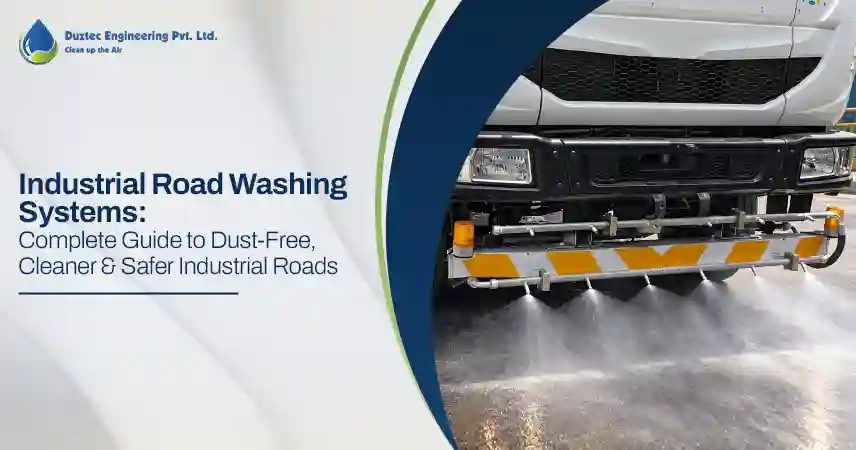
Industrial Road Washing Systems: The Complete Guide to Cleaner, Safer Industrial Roads
The dust problem may not start inside your plant. It may start on the road.
Every truck, dumper, loader and heavy vehicle moving across an industrial site can disturb dust, mud and loose material accumulated on internal roads. In high-traffic facilities, repeatedly driving over the same dusty surface can turn settled material into airborne dust again.
That makes industrial road cleaning more than a housekeeping task. It can form an important part of a broader industrial dust suppression strategy.
The Central Pollution Control Board (CPCB) recommends preventive measures to minimise dust build-up on industrial roads and identifies regular sweeping, vacuum sweeping and water flushing among road-dust control measures.
So, where does a road cleaning machine fit into industrial dust management?
This guide explains how an Industrial Road Washing System works, which industries need it, what problems it addresses and what to consider before choosing a system.
Why Industrial Roads Become a Dust Problem
Industrial roads experience conditions that ordinary roads rarely face.
Heavy vehicles continuously transport raw materials, finished products, minerals, coal, cement, metal and construction materials. Small quantities of these materials can fall or accumulate along travel routes.
Once deposited, vehicle tyres disturb the material and generate dust. Dry weather and high vehicle traffic can make the problem more noticeable.
The World Health Organization identifies roadways, mining operations, industrial activities and construction among sources associated with particulate matter in outdoor air.
For industrial facilities, the challenge is therefore not simply suppressing dust in the air. It is also about managing the material that has already settled on the road.
What Is an Industrial Road Washing System?
An Industrial Road Washing System is designed to wash and clean internal industrial roads using controlled water application.
Depending on the equipment configuration, a Road Cleaning Machine can use water tanks, pumps, spray arrangements and cleaning mechanisms to remove accumulated dust, mud and industrial residues from road surfaces.
A Truck Mounted Road Washing Machine offers mobility, allowing one vehicle-mounted system to service different internal roads, production zones, loading areas and high-traffic routes.
The basic principle is straightforward:
Wash the accumulated material → remove it from the road → reduce the amount available for re-suspension.
This makes road washing different from simply sprinkling water over a dusty surface.
5 Industries Where Road Washing Matters Most
1. Construction & Demolition Sites
Construction and demolition sites deal with excavation soil, concrete debris, aggregates and constant truck movement.
Roads connecting excavation areas, material storage zones and site exits can quickly collect dust and mud.
A mobile Road Washing Machine can help maintain these routes by cleaning accumulated material and supporting the site's wider dust-control programme.
For large infrastructure projects, this can be particularly useful where dozens or hundreds of vehicle movements occur every day.
2. Mining Operations
Mining sites are among the most demanding environments for industrial road cleaning.
Haul trucks, dumpers and loaders move continuously between extraction areas, stockpiles, crushers and processing facilities. The combination of heavy traffic and loose mineral material can create persistent road-dust challenges.
A truck-mounted cleaning system can be deployed across different routes instead of relying entirely on manual road cleaning.
3. Cement Plants
Cement plants handle limestone, clinker, gypsum, coal, fly ash and other bulk materials.
Material transfer and vehicle movement can result in dust settling along internal roads and loading areas.
Regular washing can help remove accumulated material before repeated traffic disturbs it.
For cement facilities, road washing can complement other controls such as enclosed material handling, housekeeping and process-level dust collection.
4. Metal & Steel Industries
Steel plants, foundries and metal-processing facilities handle raw materials such as iron ore, coal, coke and aggregates.
Roads can collect fines, material residues and mud from heavy vehicle movement.
A dedicated Road Cleaning System can help keep high-traffic routes cleaner and reduce the amount of loose material available to become airborne.
5. Coal & Power Plants
Coal handling areas present another significant road-cleaning challenge.
Trucks and other vehicles can transport coal residues between storage yards, unloading areas and processing zones. Road surfaces can consequently accumulate fine material.
Regular industrial road washing helps remove these deposits and supports overall housekeeping and dust suppression practices.
WHO notes that industrial facilities and coal-fired power plants are among the sources contributing to outdoor air pollution.
Road Washing vs. Road Sprinkling: What's the Difference?
This is an important distinction.
A Truck Mounted Water Sprinkler System primarily distributes water over a road to suppress airborne dust or dampen the surface.
A road washing system, on the other hand, is intended to clean the surface and remove accumulated material.
Both approaches can have a role, but they address different stages of the dust problem.
For facilities where roads repeatedly accumulate mud, dust and industrial residues, cleaning the surface can be an important part of the overall strategy.
What About a Street Cleaner Truck?
The term street cleaner truck is generally associated with municipal or urban road-cleaning equipment. Industrial facilities, however, may require equipment configured around their own road widths, traffic patterns, water availability and material-handling conditions.
Similarly, terms such as truck mounted cleaning and truck mounted cleaning system describe a broad category of mobile cleaning equipment.
A truck mount carpet cleaning machine or truck mount carpet cleaner, for example, is designed for carpet and upholstery cleaning—not industrial road washing. Choosing equipment based only on the word "truck-mounted" can therefore lead to the wrong solution.
The application should determine the machine configuration.
How Duztec Engineering Helps
Duztec Engineering provides Industrial Road Washing Systems for dust-intensive industrial environments where vehicle movement, material handling and site operations contribute to road contamination.
The system is designed to wash internal roads and remove accumulated dust, mud and industrial material. By reducing the loose material available for re-suspension, it supports cleaner roads, safer working conditions and more controlled industrial dust management.
What Should You Consider Before Choosing a System?
Before investing in an Industrial Road Washing System, assess:
-
Road dimensions: Width, length and surface condition
-
Traffic intensity: Number and type of vehicles using the roads
-
Dust load: Type and quantity of material accumulating
-
Water availability: Source, storage and recycling possibilities
-
Cleaning frequency: Daily, periodic or requirement-based cleaning
-
Site layout: Distance between cleaning areas
-
Material handled: Coal, cement, minerals, aggregates, metal residues or construction debris
The right system should match the site's actual operating conditions rather than simply being selected by tank capacity or vehicle size.
Conclusion: Cleaner Roads Start With Better Dust Management
Industrial road dust is often treated as a secondary housekeeping issue, but for high-traffic facilities, it can become a recurring operational challenge.
Construction sites, mines, cement plants, metal industries and coal and power facilities all have different sources of road contamination. Yet the principle remains similar: material that accumulates on a road can be disturbed by the next heavy vehicle that passes over it.
An Industrial Road Washing System addresses this problem by washing accumulated dust, mud, and industrial material from internal roads. Used alongside other dust-control measures, it can contribute to cleaner surfaces, improved housekeeping, and a more controlled industrial environment.
Is your facility only suppressing airborne dust, or is it also removing the dust that keeps getting re-suspended from your roads?
FAQs
1. What is an Industrial Road Washing System?
An Industrial Road Washing System is equipment designed to wash internal industrial roads and remove accumulated dust, mud and material residues caused by vehicle movement and industrial operations.
2. How does a Road Washing Machine help control dust?
It removes dust and loose material from road surfaces, reducing the quantity of material that can be disturbed and re-suspended by heavy vehicle traffic.
3. Which industries use industrial road cleaning systems?
Common applications include construction and demolition, mining, cement manufacturing, steel and metal processing, coal handling, power plants, ports and bulk-material facilities.
4. Is a truck-mounted road washing machine suitable for mining and cement plants?
It can be suitable where mobility across large internal road networks is required. The appropriate configuration depends on road dimensions, traffic, dust load, water availability and site conditions.
5. Is road washing the same as water sprinkling for dust suppression?
No. Water sprinkling primarily wets the surface and suppresses dust temporarily, while road washing focuses on cleaning and removing accumulated material from the road.
6. How often should industrial roads be washed?
There is no universal frequency. It depends on traffic volume, dust generation, weather, material handled and the rate at which dust and mud accumulate on the road.