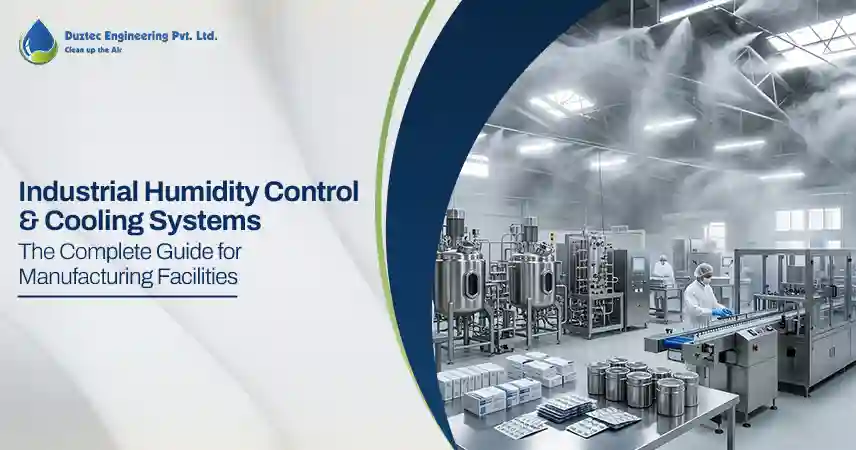
Industrial Humidification System: The Complete Guide to Humidity & Cooling Control
Your factory may be losing production consistency because of something you cannot see moisture in the air.
Too much humidity can contribute to condensation and corrosion. Too little can increase static electricity and affect moisture-sensitive materials. Add machinery-generated heat, seasonal weather changes and large production spaces, and maintaining a stable manufacturing environment becomes considerably more difficult.
That is where an Industrial Humidification System can become part of a wider temperature and humidity-control strategy.
ASHRAE notes that humidity requirements in industrial processes depend on factors including moisture content, product accuracy, corrosion and static electricity. It also highlights that both excessive humidity and low humidity can create different operational challenges.
But humidification is only one side of the equation. Some factories need cooling, some need dehumidification, and others require a combination.
This guide explains how industrial humidity and cooling systems work, which industries use them, how industrial cool mist humidifiers and Mist Cooling Systems fit into the picture, and what manufacturers should consider before choosing a solution.
Why Temperature & Humidity Control Matter in Manufacturing
Manufacturing facilities constantly generate heat through machinery, production processes, lighting, and people. At the same time, moisture can enter through outdoor air, washing processes, steam, raw materials, and production activities.
An uncontrolled environment can create problems such as:
-
Excessive heat around production equipment
-
Condensation on cold surfaces
-
Corrosion and material deterioration
-
Static electricity
-
Moisture-related product variation
-
Poor worker comfort
-
Unstable process conditions
ASHRAE identifies temperature, humidity, air movement, air quality and cleanliness as key elements of the process environment in industrial air-conditioning design.
The important point is that there is no universal temperature or humidity setting for every factory. The correct conditions depend on the product, process, equipment and facility.
What Is an Industrial Humidification System?
An Industrial Humidification System adds controlled moisture to air when the relative humidity is below the level required by a manufacturing process.
Depending on the application, humidification may use technologies such as:
-
Fine water mist
-
Steam humidification
-
Evaporative humidification
-
High-pressure humidification
-
Automated humidity controls and sensors
A Cool Mist Humidifier or Industrial Cool Mist Humidifier can disperse fine water droplets that evaporate into the surrounding air. When designed appropriately for the space and climate, this can provide both moisture management and an evaporative cooling effect.
However, humidification should not be confused with simply spraying water into a factory. The system needs to deliver controlled moisture without creating wet surfaces, excessive local humidity or contamination risks.
How Mist Cooling Systems Help Manage Factory Heat
In hot manufacturing environments, cooling can be challenging when the facility has a large floor area or substantial heat-generating equipment.
Mist Cooling Systems use very fine droplets that evaporate into the surrounding air. The evaporation process can absorb heat and reduce the perceived or actual air temperature in suitable conditions.
A Factory Cooling System can therefore be particularly useful for:
-
Large production floors
-
High-heat work zones
-
Warehouses
-
Loading and dispatch areas
-
Workshops
-
Areas with substantial machinery heat
A Warehouse Mist Cooling System, for example, can provide targeted cooling in large spaces where conventional room-by-room air conditioning may not be practical.
The effectiveness of evaporative cooling depends strongly on ambient humidity. Drier air generally provides greater evaporation potential, while already-humid conditions limit the cooling effect.
6 Industries That Benefit From Humidity & Cooling Control
1. Pharmaceutical Manufacturing
Pharmaceutical facilities require carefully controlled environmental conditions because temperature and relative humidity can affect materials, products and equipment.
WHO guidance states that, where appropriate, temperature and relative humidity should be controlled, monitored and recorded according to the requirements of materials and products while providing suitable conditions for operators.
A Pharmaceutical Humidifier Solution may therefore be considered where a manufacturing process requires controlled humidity rather than simply general cooling.
The system must be designed around the facility's GMP requirements and contamination-control strategy.
2. Food & Beverage Processing
Food processing facilities often generate substantial heat and moisture from cooking, washing, steam and production equipment.
Excess humidity can contribute to condensation, while excessive heat can make production areas uncomfortable.
Humidity and cooling control can help maintain more consistent conditions around processing, packaging and storage areas.
3. Paper & Printing Industry
Paper and other hygroscopic materials respond to changes in environmental moisture.
Rapid changes in humidity can affect material behaviour, handling and dimensional stability, making environmental consistency important for certain printing and converting processes.
ASHRAE specifically identifies moisture content, product uniformity and static electricity among reasons why industrial processes may require humidity control.
An appropriate Industrial Humidification System can therefore help maintain the environmental conditions required by a particular paper or printing process.
4. Electronics & Electrical Manufacturing
Electronics facilities have a particularly important relationship with humidity because of electrostatic discharge.
Very low humidity can promote static electricity, while excessive humidity can create condensation-related concerns. ASHRAE notes that controlled relative humidity is important for electronic equipment and identifies static electricity as a concern at low humidity.
For sensitive production areas, humidity monitoring and process-specific environmental controls can be essential.
5. Metal & Engineering Industry
Metal manufacturing facilities often deal with high heat from furnaces, welding, machining and other processes.
Humidity also matters because moisture and condensation can contribute to corrosion-related problems.
ASHRAE notes that temperature and humidity conditions can be important in manufacturing metal products, particularly where corrosion, surface quality and worker conditions are concerns.
Cooling systems can be used to manage high-heat areas, while humidity control addresses moisture-related requirements.
6. Automotive Manufacturing
Automotive plants combine welding, machining, painting, assembly, component storage and inspection.
Different production zones may therefore require different environmental conditions.
A properly designed cooling and humidity-control strategy can help maintain more stable conditions around sensitive processes, materials and work areas rather than treating the entire plant as one uniform space.
Humidification vs Cooling: Which Does Your Factory Need?
This is where many facility managers make the wrong starting assumption.
If humidity is too low: an Industrial Humidification System may be required.
If temperature is too high: a Factory Cooling System or targeted cooling solution may be appropriate.
If humidity is too high: dehumidification may be necessary.
If heat and low humidity occur together: an Industrial Cool Mist Humidifier or other evaporative solution may potentially address both, provided site conditions support evaporation.
If the process requires tight control: integrated HVAC, sensors, humidification and dehumidification may be needed.
The correct solution should therefore begin with measuring the actual temperature and relative humidity profile of the facility.
How Duztec Engineering Helps Manufacturing Facilities
Duztec Engineering provides industrial cooling and humidity-control solutions designed for manufacturing environments dealing with excessive heat, humidity and uncomfortable working conditions.
Its solutions can help regulate temperature and moisture while supporting product protection, machinery performance and a more comfortable working environment.
For larger facilities, the right solution may involve targeted cooling, humidification or a combination designed around the specific process and space.
What to Check Before Choosing a System
Before selecting an industrial cooling or humidification solution, evaluate:
1. Required humidity range: What relative humidity does the process actually need?
2. Heat load: Which machines and processes generate the most heat?
3. Moisture load: Where is moisture entering the facility?
4. Space characteristics: What is the floor area, ceiling height and ventilation pattern?
5. Operating conditions: How do temperature and humidity change throughout the day and across seasons?
6. Monitoring: Can temperature and relative humidity be measured continuously?
7. Water quality: Is the available water suitable for the selected humidification technology?
These factors determine whether you need humidification, cooling, dehumidification or an integrated approach.
Conclusion
Temperature and humidity are not simply comfort variables inside a manufacturing plant. They can influence materials, machinery, product consistency, static electricity, condensation and the working environment.
From pharmaceutical and food-processing facilities to paper mills, electronics factories, metal plants and automotive manufacturing, each industry has different environmental requirements.
An Industrial Humidification System, Industrial Cool Mist Humidifier or Mist Cooling System can play a role in maintaining those conditions when correctly matched to the facility, climate and process.
The goal is not simply to make a factory cooler or more humid. It is to create a stable, measurable and process-appropriate environment.
Is your facility measuring temperature and humidity as part of production control—or only reacting when environmental conditions start affecting the process?
Frequently Asked Questions
1. What is an Industrial Humidification System?
An Industrial Humidification System adds controlled moisture to the air to maintain the humidity range required for a particular manufacturing process, material or working environment.
2. What is an Industrial Cool Mist Humidifier?
An Industrial Cool Mist Humidifier disperses fine water droplets into the air. As the droplets evaporate, they add moisture and can provide evaporative cooling where environmental conditions are suitable.
3. Can a cool mist humidifier also cool a factory?
It can provide evaporative cooling in suitable conditions. The cooling effect depends on factors such as ambient temperature, relative humidity, airflow and evaporation potential. It should not automatically be treated as a replacement for every industrial cooling system.
4. Which industries need industrial humidity control?
Pharmaceuticals, food and beverage, paper and printing, electronics, electrical manufacturing, metal processing, automotive manufacturing and other process-sensitive industries may require controlled humidity.
5. What humidity level is best for a manufacturing facility?
There is no single ideal humidity level for every facility. The correct range depends on the process, product, materials and equipment. ASHRAE notes that humidity requirements are application-specific and can relate to moisture content, product uniformity, corrosion and static electricity.
6. What is the difference between a humidifier and a mist cooling system?
A humidifier primarily adds controlled moisture to the air. A mist cooling system uses fine droplets that evaporate and absorb heat, providing cooling while also adding moisture. The appropriate technology depends heavily on the ambient climate and process requirements.